Great solutions start with the right questions. Find the answers you need right here.
Still have a question? Don’t hesitate to Contact us. We’re more than happy to help.
Great solutions start with the right questions. Find the answers you need right here.
Still have a question? Don’t hesitate to Contact us. We’re more than happy to help.
Start with the function the ingredient needs to perform in your formulation and process. Consider the technical characteristics that are most relevant to your application, such as composition, hydration behaviour, particle profile, texture or other functional requirements. Product information and specifications can help you shortlist suitable options, but they cannot predict finished-product performance. The selected ingredient should therefore be tested under representative formulation and processing conditions.
Different grades within the same ingredient range may vary in composition, particle profile, treatment or other relevant characteristics. Begin by defining the requirements of your application and compare only the grades that have a clear connection to those requirements.
Use the current product-specific information for the exact grade under evaluation and confirm its performance through application testing where functionality is important.
Compare the exact proposed ingredient and grade with your current purchasing specification. Focus on the criteria that matter to your application, such as ingredient identity, composition, physical characteristics, microbiological limits and relevant functional or quality requirements.
A specification comparison can identify important differences, but it does not establish equivalent application performance. Where functionality matters, complete the comparison with a representative application trial using your current ingredient as the benchmark.
An equal-weight replacement should not automatically be assumed. Ingredients with similar descriptions or specification values can still behave differently in a formulation or production process.
Compare the required function, dosage, water balance, process behaviour and target finished-product characteristics. Use your current formulation as the control and validate the selected ingredient under representative conditions before confirming a replacement level.
A product specification defines important ingredient characteristics, but it cannot predict every interaction within your formulation or production process. Dosage, water balance, temperature, equipment and other ingredients may all influence the final result.
Use specifications to select relevant options, then evaluate the selected ingredient in your intended formulation and process. Focus on the finished-product characteristics that are most important to your application.
Share your intended application, the main function you expect from the ingredient and any essential technical requirements. It is also useful to explain what you want the trial to demonstrate and, where relevant, which current ingredient will be used as a benchmark.
This information helps identify the most relevant product or grade for your initial evaluation.
Test the selected ingredient under conditions that are representative of your intended formulation and production process. Use your current ingredient or formulation as a control where possible and define the most important acceptance criteria before testing.
The specification provides a technical starting point, while the application trial determines whether the ingredient delivers the required performance in your specific product and process.
Only information explicitly identified as a specification or guarantee should be treated as a guaranteed product criterion. Typical nutritional values, product descriptions and application information can provide useful context, but they do not automatically have the same status.
Always use the current information for the exact product and grade being evaluated, particularly when comparing ingredients or approving a new supplier.
The documentation required depends on the ingredient, application, destination market and your internal approval process. A qualification normally starts with the current grade-specific specification and the quality, food-safety, allergen, GMO and regulatory information relevant to your requirements.
Additional certification or supporting information may also be required. Always check that the documentation applies to the exact product, grade and production context under evaluation.
Focus on the requirements relevant to your finished product and target market. This may include ingredient identity, quality criteria, allergen and GMO information, microbiological requirements, regulatory information and relevant certifications.
Requirements and status may differ by product, grade, production site or destination. Quality and compliance information should therefore be verified for the exact ingredient being considered.
Not necessarily. Certifications, quality requirements and compliance information may differ between products, grades, production sites and destination markets.
A certification or status stated for one product should therefore not automatically be applied to an entire ingredient range. Always use the current documentation applicable to the exact ingredient being evaluated.
Check the shelf life and storage requirements for the exact product and grade you are considering. Assess whether the stated conditions are compatible with your warehousing, stock rotation and ingredient-handling practices.
Keep in mind that an ingredient’s shelf life does not determine the shelf life of your finished product. Finished-product stability depends on the complete formulation, processing, packaging and storage conditions.
Packaging options may vary depending on the product, grade, production site, destination or order. A packaging format shown for an ingredient range should therefore not automatically be considered available as standard for every product.
The appropriate packaging should be discussed in relation to expected volume, destination and your receiving, storage and production-handling requirements.
Consider whether the available packaging and handling options fit your receiving, warehousing and production environment. Intake equipment, internal handling, storage requirements and expected volumes can all be relevant when evaluating operational fit.
Packaging suitability should be considered alongside, but separately from, technical application performance.
Start by confirming that the ingredient meets your technical, quality and application requirements. Evaluate the selected product at the intended dosage and under representative processing conditions.
A successful laboratory trial does not automatically confirm full manufacturing suitability. Packaging, documentation, handling and purchasing requirements should therefore also be reviewed before commercial implementation.
Technical approval establishes whether an ingredient meets the required specification, quality, compliance and application criteria. Commercial selection considers whether the same ingredient also fits your purchasing and operational requirements.
Factors such as price, packaging, expected volume, order requirements, timing and availability should therefore be assessed separately from technical performance. A technically suitable product is not automatically the most appropriate commercial choice.
Separate the evaluation into technical, operational and commercial fit. Compare the proposed ingredient with your current specification and assess the characteristics that matter most to your formulation and process.
Where finished-product performance matters, use your current ingredient as the benchmark in a representative trial. Packaging, order requirements, availability and commercial conditions should then be reviewed separately before implementation.
Once an ingredient has demonstrated technical potential, discuss the commercial and operational conditions relevant to the intended order. These may include price, expected volume, packaging, minimum order quantity, lead time and regional availability.
These conditions may differ by product, destination and order and should not be inferred from technical product information alone.
This website uses cookies to improve the browsing experience. Some cookies are necessary for the proper functioning of the website. You can refuse cookies, but this may impact the browsing experience. More info
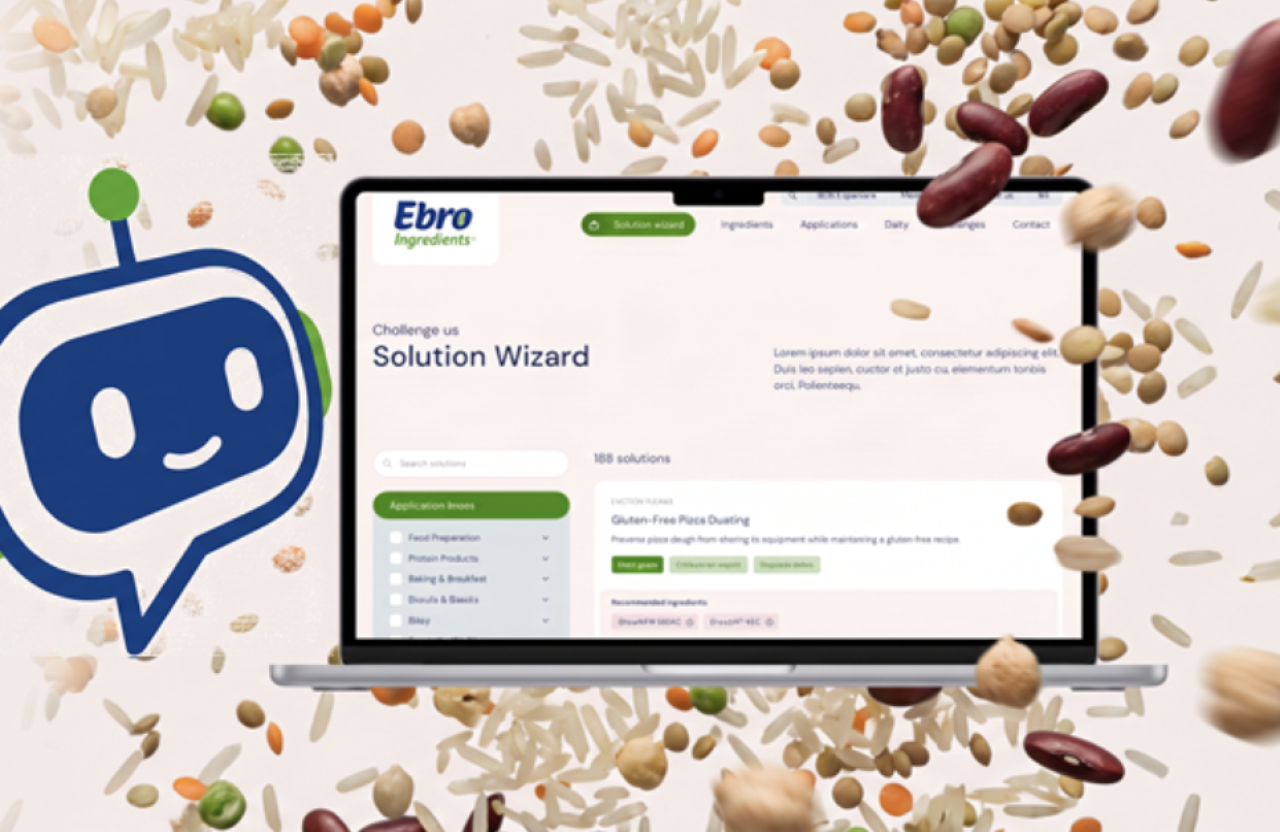
The Ebro Ingredients Solution Wizard guides you to the most suitable solution in just a few clicks.